
EOH - Excellence in Obscurity Happens Here
A satirical sketch. The scene and dialogue are invented.
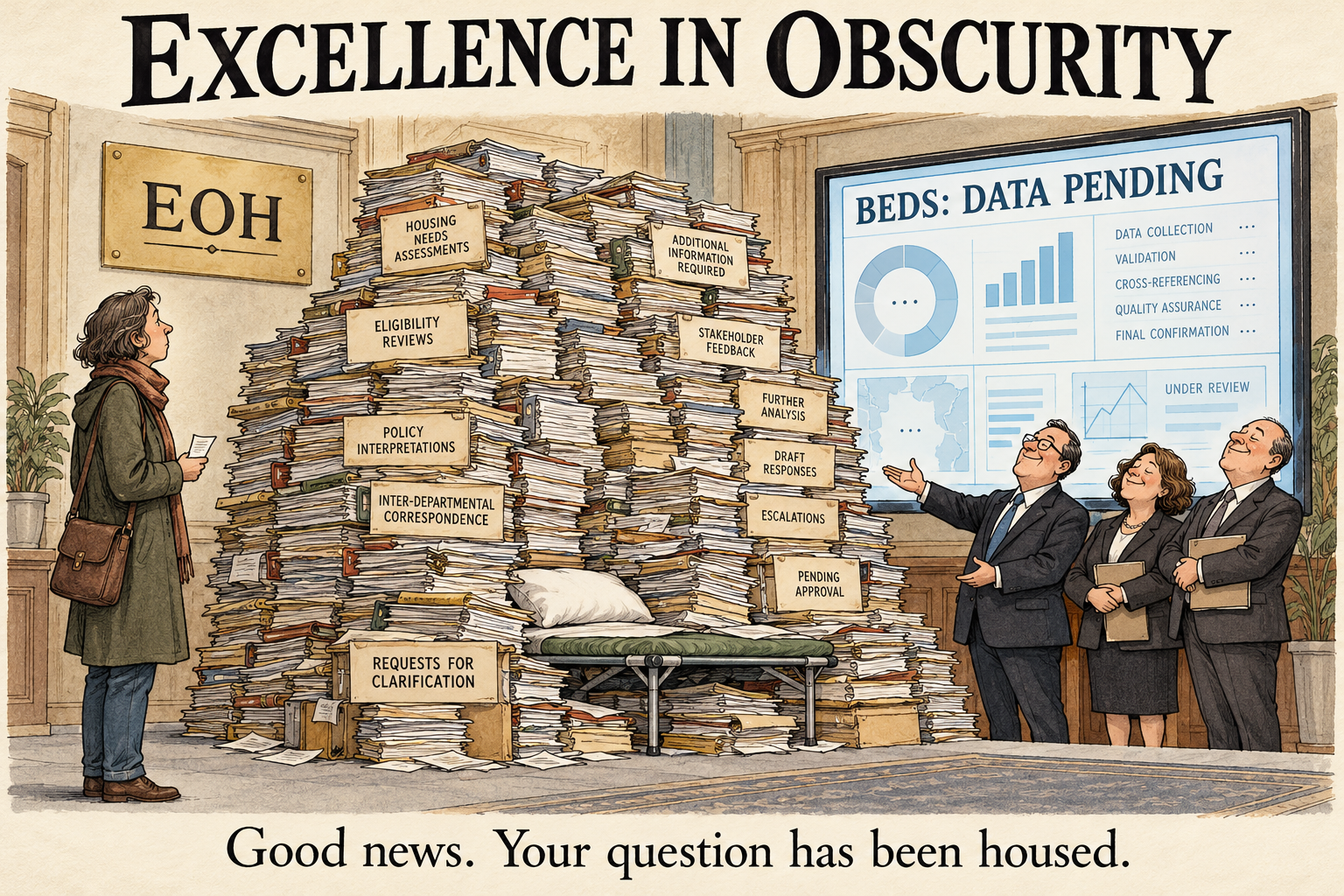
A citizen asks a simple question.
“How many shelter beds are available tonight?”
There is a pause. Somewhere in the building, a printer wakes up.
The question has arrived in the wrong condition. It is short, understandable, and connected to something that must happen before morning. It contains none of the protective language that allows an institution to handle an emergency at a comfortable distance.
The citizen is directed to submit a records request.
“I’m just looking for a number.”
“Yes,” comes the reply. “You’ll want to be specific.”
So the citizen writes: How many shelter beds are available tonight?
This is acknowledged promptly. The acknowledgment contains no beds, but it does establish that the question has entered a building.
The next problem is the word “available.”
Does the citizen mean funded beds, contracted beds, licensed beds, staffed beds, occupied beds, or beds that appear in a presentation beneath a photograph of people shaking hands?
“I mean beds someone could sleep in.”
The office appreciates the clarification. Unfortunately, this introduces an operational component.
A bed can exist financially without existing physically. It can exist physically without being staffed. It can be staffed without being accessible to the particular person standing outside. These distinctions are important, and the office would hate to mislead anyone by producing a useful total.
The request is forwarded for review.
By now, “tonight” has expired. The citizen updates the question. This creates a new version.
At a meeting, the question is discussed by people seated around a table large enough to accommodate several people lying down. This observation is not included in the minutes.
Someone suggests a dashboard.
Everyone is relieved. A dashboard would give the question somewhere attractive to live.
There will be filters. There will be categories. There will be an explanatory note warning that the information should not be used to determine whether a bed is available.
A communications plan is proposed to announce improved access to the information.
The citizen asks whether anyone has the number in a spreadsheet.
This is received as an unfortunate simplification of the work.
Meanwhile, the records request advances. The citizen learns that finding the answer may involve searching, reviewing, sorting, and preparing material for release. An estimate will follow.
The public has already paid to create the records, paid to store them, and paid the salaries of the people discussing them. It must now consider the additional cost of becoming informed.
The estimate has a reassuring effect on the process. For the first time, the office is able to offer the citizen a number.
It is the price of asking.
The citizen narrows the request.
This is an important stage in public participation: reducing the question until the answer becomes affordable.
Could the office simply provide the most recent bed count?
Which count?
The one used to make decisions.
Which decisions?
The citizen begins to understand why the presentations contain so many arrows. Every arrow offers a direction. None accepts responsibility for the destination.
Another meeting is scheduled.
By this point, the original question has acquired a history, an owner, several recipients, and a folder. It has become better accommodated than the person whose circumstances prompted it.
Outside this imagined office, the stakes are easy enough to understand. A person needs somewhere safe to sleep. A family needs an answer before the battery dies. A worker trying to help needs information that survives contact with the front desk.
Nobody is improved by learning, late in the evening, that capacity and availability are separate reporting categories.
There are people inside these systems doing difficult work with inadequate resources. They deserve usable information too. An institution that makes a straight answer difficult burdens the person answering the phone as well as the person calling.
Yet the machinery keeps producing evidence of its own motion.
The agenda is circulated. The minutes are approved. The working group reports back. Progress is described in verbs that require no finished object: engaging, exploring, coordinating, advancing.
The citizen checks the status of the request.
It remains active.
This is good news for the request. It has survived every stage of the process. It has received sustained attention. Its continued existence is documented.
“How many shelter beds are available tonight?” the citizen asks again.
The office thanks them for their patience.
By morning, another night will have passed without a usable answer. The paperwork, however, will be in excellent order.
EOH. Excellence in Obscurity Happens Here.
Somewhere else, someone still needs a bed.