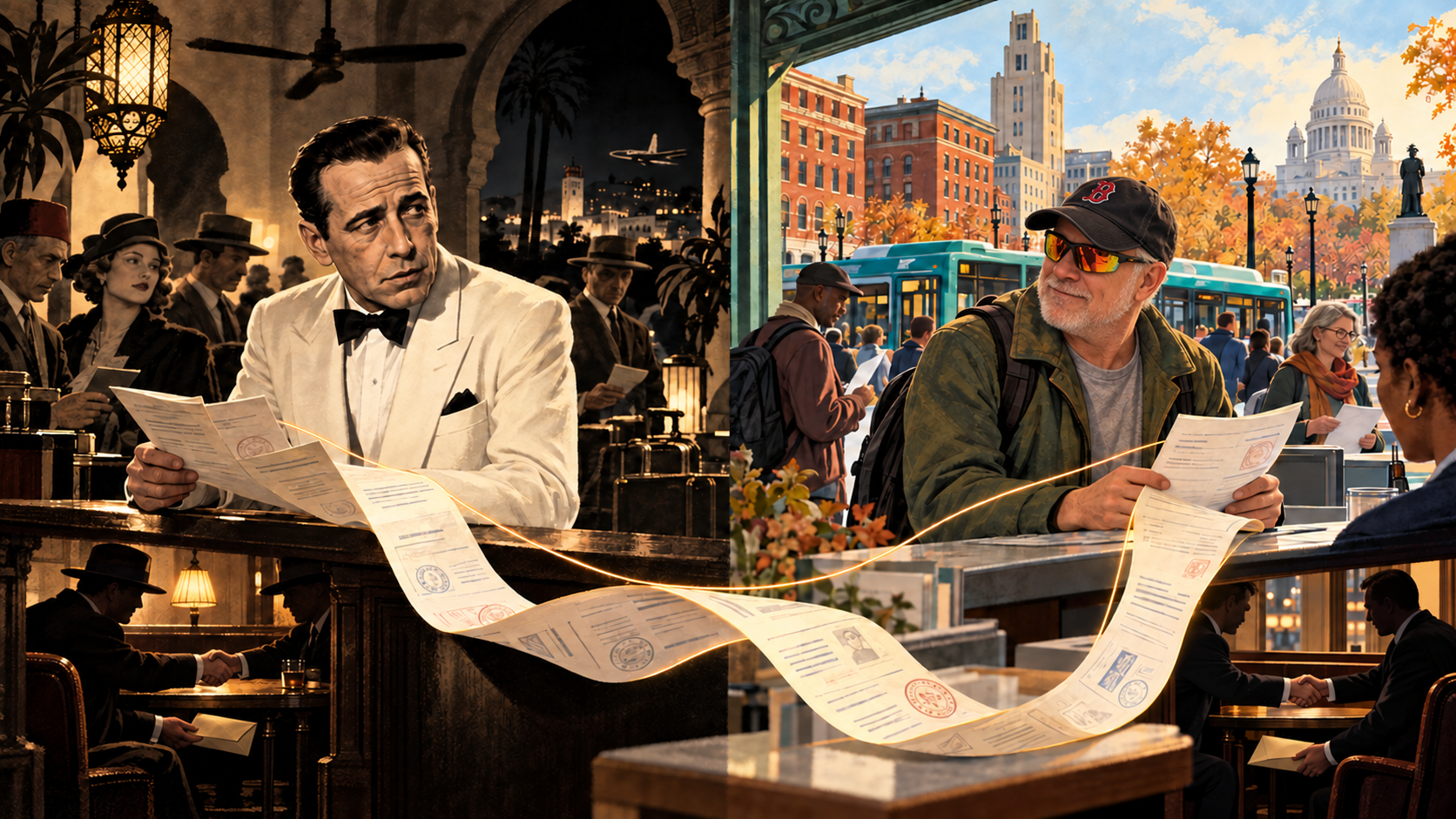
There is a certain kind of place where the whole city eventually walks past.
Kennedy Plaza is one.
A bus arrives.
A bus does not arrive.
A man is looking for a shelter bed.
A woman is trying to replace an ID.
Someone is late for court.
Someone has three plastic bags containing everything important enough not to lose.
Someone knows exactly which office to go to.
Someone else has been sent to the wrong one twice.
A caseworker crosses the street carrying coffee.
A police officer watches traffic.
A politician passes through occasionally, usually with somewhere else to be.
And somewhere nearby, someone says the most useful sentence in American civic life:
“I know a guy.”
That sentence is worth studying.
Because between the government website and the man who knows a guy lies a large part of how America actually works.
HOPE began there.
Not literally at Kennedy Plaza, although enough of it has passed through Kennedy Plaza that we may eventually owe the place royalties.
It began with a much simpler question:
If somebody needs help, how do they actually get it?
Not theoretically.
Not according to the organizational chart.
Not according to a strategic plan containing seventeen arrows and a reassuring amount of blue.
Actually.
A real person.
A real problem.
A Tuesday afternoon.
Maybe five dollars.
Maybe no car.
Maybe no printer.
Maybe a phone with 11 percent battery.
Maybe a backpack containing every document the person has managed not to lose.
Where do they go?
Who do they call?
What do they bring?
Who decides?
What happens next?
And what happens when the answer is wrong?
That last question turned out to be important.
Because systems are usually very good at describing what should happen.
Human beings have the peculiar habit of encountering what actually happens.
That gap is where HOPE lives.
In Casablanca, everybody needed papers.
Papers to travel.
Papers to leave.
Papers proving who you were.
Papers issued by somebody with authority.
Papers stamped by somebody with slightly more authority.
The entire moral universe of the place seemed to depend on whether somebody had the correct piece of paper at the correct moment.
Providence is considerably safer than wartime Casablanca.
The coffee is different.
So are the hats.
But the papers survived.
Birth certificate.
Social Security card.
State ID.
Lease.
Benefit notice.
Disability determination.
Proof of residence.
Proof of income.
Proof of no income.
Proof that the previous proof is still proving whatever it was originally supposed to prove.
Modern civilization has developed astonishing technology, but if you lose one laminated rectangle, there is still a reasonable chance that your life will become an administrative scavenger hunt.
Try replacing an ID while homeless.
You may need identification to obtain identification.
You may need an address.
You may need transportation.
You may need access to a computer.
You may need to receive mail.
You may need money.
You may need another document proving that the document you do not currently possess once existed.
At this point the problem is no longer the ID.
The problem is society.
That was one of the first surprises.
Follow almost any practical problem far enough and eventually you meet the entire country.
Housing meets transportation.
Transportation meets employment.
Employment meets identification.
Identification meets government records.
Government records meet technology.
Technology meets access.
Access meets money.
Money meets housing.
And suddenly we are back where we started.
A perfect circle.
Very elegant.
Completely useless to the person standing in the middle of it.
This is where HOPE changed.
Originally, we thought we were building a better way to find services.
Shelter.
Food.
Documents.
Transportation.
Legal help.
Housing.
The normal categories.
But categories are how institutions organize themselves.
People do not wake up inside categories.
Nobody wakes up at 6:30 in the morning thinking:
“Today I shall interact with the transportation sector.”
They think:
I need to get to the DMV.
Or:
I need somewhere to sleep tonight.
Or:
My benefits stopped.
Or:
I got this letter and have no idea what it means.
Or:
Someone told me to go somewhere, but I forgot where, and my phone died.
That is a journey.
And journeys cross institutions.
The citizen moves.
The bureaucracy stays where it is.
This difference explains a great deal.
One agency sees the housing problem.
Another sees the transportation problem.
Another sees the paperwork problem.
Another sees the health problem.
Another sees the employment problem.
Each may be doing its job perfectly well.
And the person can still fail.
Because nobody necessarily owns the distance between the doors.
That distance became interesting to us.
Very interesting.
Possibly unhealthily interesting.
We began mapping it.
Then something unexpected happened.
HOPE stopped being merely an app.
It began becoming an experiment.
Not an experiment on homeless people.
We have had quite enough programs examining poor people as if poverty were an exotic behavioral condition occurring in the wild.
The citizen is not the specimen.
The system is.
That single reversal changes the research question.
Instead of asking:
Why didn't this person follow through?
Ask:
What happened between the referral and the outcome?
Instead of:
Why didn't she get the document?
Ask:
How many documents were required?
Instead of:
Why did he miss the appointment?
Ask:
Could he physically get there?
Instead of:
Why didn't the resident understand the instructions?
Ask:
Were the instructions understandable?
Instead of:
Why did the referral fail?
Ask:
Did anyone ever confirm that the receiving organization could actually accept it?
These are different questions.
They produce different data.
And, inconveniently, they occasionally reveal different answers.
America loves referrals.
Referrals are wonderful because they allow responsibility to move without anybody having to physically carry it.
Organization A refers you to Organization B.
Organization B explains that Organization C handles that.
Organization C suggests calling Organization A.
Congratulations.
You have completed the Rhode Island Civic Triangle.
No aircraft have ever been recovered.
The institution may record three successful interactions.
The resident records one wasted afternoon.
Both records are technically correct.
This is precisely why the journey matters.
HOPE is increasingly interested in what happens between:
“Here is a phone number”
and
“The problem moved forward.”
Those are not the same thing.
A phone number is not an outcome.
A referral is not an outcome.
A website is not an outcome.
Even an application is not necessarily an outcome.
The important question is much less glamorous:
Did the person reach a viable next step?
That phrase has become important to us.
A viable next step means a person knows what to do next, where to do it, what to bring, who owns the next move, what should happen afterward and what to do if the expected route fails.
That sounds modest.
It is not.
There are entire bureaucracies that would benefit from discovering what happens next.
Power also looks different from this angle.
We tend to imagine power standing behind podiums.
Governors.
Mayors.
Agency directors.
CEOs.
People whose calendars require assistants.
That is certainly power.
But civilization contains quieter varieties.
Power is knowing which office.
Power is knowing which form.
Power is knowing that the form changed last month.
Power is having transportation.
Power is owning a printer.
Power is knowing which person answers the phone.
Power is understanding that the sentence “we don't do that” occasionally means “the person currently speaking to you does not know that we do that.”
Power is having somebody who can say:
“No, no. You need Mary on the third floor.”
People who spend their lives inside institutions accumulate this knowledge without noticing it.
It becomes invisible capital.
Then one day you fall outside the institution.
Suddenly you discover how wealthy everybody else is.
They know the passwords.
Not computer passwords.
Civic passwords.
Who to call.
What to say.
What not to say.
Which entrance.
Which hour.
Which document.
Which exception.
Which person.
We call this navigation.
But navigation is a polite word for access to power.
Homelessness teaches this lesson quickly.
From a distance, homelessness looks stationary.
A person sitting on a bench.
A tent.
A shelter bed.
A photograph.
From inside it, homelessness is movement.
Constant movement.
Moving possessions.
Moving between buildings.
Moving to charge a phone.
Moving for food.
Moving for bathrooms.
Moving for appointments.
Moving because somewhere closed.
Moving because somewhere opened.
Moving because someone told you the answer was twelve blocks away.
And at every stop:
verification.
Who are you?
Where do you live?
Where did you live?
What happened?
What do you earn?
What don't you earn?
Where did you sleep?
Do you have identification?
Can you prove that?
Can you prove why you cannot prove that?
There is a particular bureaucratic genius in asking a homeless person for documents whose safe storage generally requires a home.
I don't think Kafka thought of that one.
He would have admired it.
Then there is public money.
This is where the experiment becomes even more interesting.
America spends enormous amounts of money solving social problems.
Federal money.
State money.
Municipal money.
Foundation money.
Hospital money.
Nonprofit money.
Grant money.
Emergency money.
Pilot money.
Money devoted to studying why the previous money did not achieve the expected result.
Eventually someone produces a handsome report.
The report tells us how much money was allocated.
How many programs were funded.
How many people were served.
How many referrals occurred.
All legitimate questions.
But there is another one.
What happened?
Not rhetorically.
Literally.
What happened next?
Did someone get housed?
Did someone obtain the document?
Did someone reach the appointment?
Did the handoff occur?
Did the institution answer?
Did the person reach a safe, understandable next step?
Did the public money change the journey?
Sometimes the answer will be yes.
That matters too.
This project is not based on the assumption that government fails.
Or that nonprofits fail.
Quite the opposite.
Some public servants perform extraordinary work inside systems that would cause lesser mammals to abandon language altogether.
Some nonprofit workers are holding entire neighborhoods together with two grants, four volunteers and a Keurig machine.
We should know where systems work.
We should know why.
And then we should copy the hell out of it.
That is one reason Guardian entered the picture.
The internet has a remarkable ability to preserve incorrect information forever.
A shelter changes hours.
A form changes.
A phone number dies.
A government page moves.
A policy changes.
Somewhere, a PDF from 2017 remains online and continues its immortal career ruining people's afternoons.
If navigation depends on information, information becomes infrastructure.
It needs maintenance.
Source.
Date.
Authority.
Confidence.
Contradiction.
What changed?
Who says?
Who actually decides?
This is not glamorous technology.
Neither is plumbing.
Try living without it.
Guardian exists because HOPE cannot responsibly tell someone what to do unless we have some idea whether the instructions are still true.
And when we do not know, the system should say so.
That may sound obvious.
It is apparently revolutionary enough to require engineering.
Then artificial intelligence arrived.
Which, naturally, caused everybody to lose their minds for a while.
AI can be useful here.
Very useful.
It can explain a government letter.
Translate instructions.
Turn bureaucratic language into human language.
Help somebody prepare questions.
Find connections across complicated systems.
But AI should not become the new clerk behind the glass.
It should not decide who deserves housing.
It should not quietly invent eligibility rules.
It should not generate confidence where evidence does not exist.
The principle is simple:
Rules decide. AI explains. The person reviews. The agency decides.
Technology should help a person understand the system.
Not become another system they are forced to obey.
That is an important distinction.
Especially because AI is very good at sounding certain.
Humans are also very good at sounding certain.
This may be one of the few areas where we have already achieved human-level performance.
And then, almost accidentally, HOPE became civic education.
A person comes looking for shelter.
They learn who controls shelter policy.
Someone comes looking for identification.
They learn how state agencies divide responsibility.
Someone gets a benefits letter.
They learn what can be appealed.
Someone encounters a bad referral.
They learn which organization actually owns the next step.
That is civics.
Not the textbook kind.
Not three branches of government floating above a Capitol dome.
Street civics.
Applied civics.
The Constitution with bus schedules.
Power with office hours.
Rights with paperwork attached.
It may be a more useful way to understand democracy.
Because democracy does not only happen on Election Day.
It happens at counters.
On hold.
Inside forms.
During appeals.
At public meetings.
Inside budgets.
In records requests.
In the tiny decisions determining who must prove what to whom.
This is where people encounter the state.
And therefore this is where the state should be studied.
I came to America as an immigrant.
There are things about this country I find brilliant.
There are things about it I find absurd.
Occasionally they are the same thing.
But one idea still strikes me as extraordinary.
You are allowed to question the machinery.
Not merely complain about it.
Question it.
Inspect it.
Request records.
Compare promises with outcomes.
Publish what you find.
Ask where the money went.
Ask who made the decision.
Ask whether the policy worked.
Ask whether anyone measured it.
Ask again when the first answer appears to have been written by a committee trying not to answer.
This is an astonishing civic permission.
And I intend to use it.
America gave me the right to question America.
It seems impolite not to.
This is why Rhode Island interests me.
It is small enough to see.
Not simple.
Nothing involving human beings is simple.
But visible.
State government.
Cities.
Universities.
Hospitals.
Nonprofits.
Foundations.
Shelters.
Advocates.
Journalists.
Researchers.
People living outside.
People trying to help them.
People responsible for programs.
People responsible for funding programs.
People studying whether the programs funded by the people responsible for funding programs are functioning.
Everybody is nearby.
The whole civic ecosystem is compressed.
Rhode Island is, in that sense, an excellent laboratory.
Not a laboratory for studying vulnerable people.
A laboratory for studying ourselves.
If you want to understand a city, don't begin with the organizational chart.
Stand where the systems meet.
Watch for a while.
Watch who gets through.
Watch who comes back.
Watch who gets sent somewhere else.
Watch which door requires which paper.
Watch where the information changes.
Watch where the money enters.
Watch where responsibility disappears.
Cities reveal themselves at their edges.
Where the official city and the lived city collide.
That is where HOPE is standing.
Taking notes.
So the experiment is becoming larger.
Can technology help a community understand itself?
Can we map civic friction without mapping vulnerable people?
Can a failed journey become evidence for improving the next one?
Can we measure the distance between public money and public outcome?
Can government, universities, nonprofits, journalists and residents look at the same evidence without immediately retreating into their respective bunkers?
Can criticism become maintenance?
Can accountability become less theatrical and more useful?
Can the person who has spent six hours being bounced between institutions teach us something the institutions cannot see from inside their own walls?
I suspect the answer is yes.
But suspicion is not research.
So we build.
We observe.
We verify.
We measure.
We publish.
We correct ourselves when we are wrong.
And occasionally, when the machinery becomes particularly absurd, we make fun of it.
Affection and scrutiny are not opposites.
You repair the house because you intend to live in it.
That may ultimately be the whole philosophy of HOPE.
We are not trying to prove that society is broken.
We are trying to understand where it breaks.
And where it works.
And why.
Different century.
Different papers.
Different city.
Same ancient human question:
How do I get from where I am to where I need to be?
Everybody eventually asks it.
And sooner or later, everybody comes to HOPE.