Satire ·
HOMELESS PEOPLE DAY
A Modest Proposal for a Country Running Out of Indoors
A work of satire. This imagined country, holiday and its events are fictional.
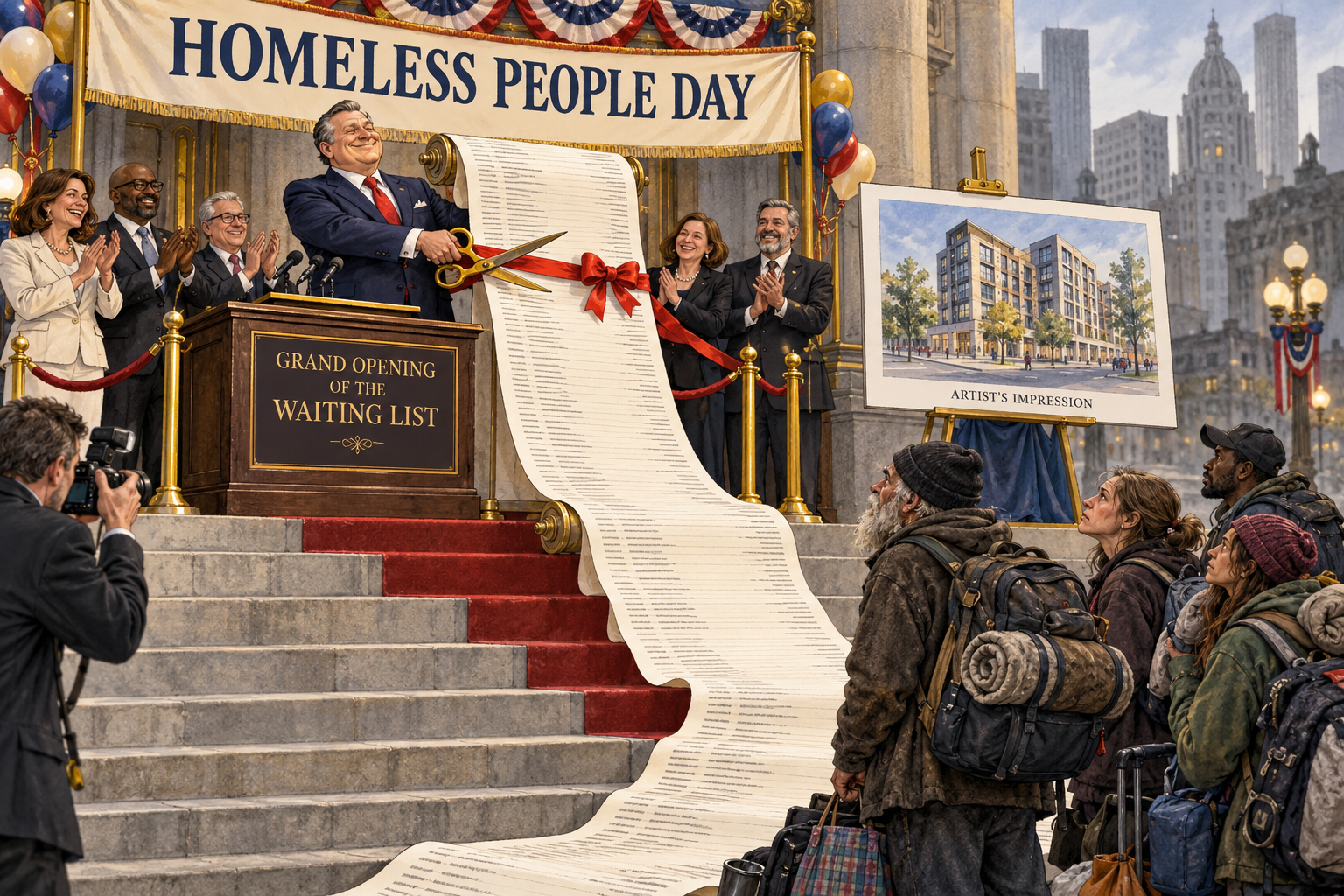
In the imaginary near-future republic considered here, ninety percent of the population is homeless. The remaining ten percent has expressed concern about what this is doing to the character of the neighborhood.
Naturally, the country needs a holiday.
A housing program would raise difficult questions about land, money, and whether a person should be allowed to sleep somewhere without first becoming an attractive investment. A holiday offers a more practical solution. It can be proclaimed immediately, photographed inexpensively, and observed without disturbing a single property portfolio.
Homeless People Day should fall in October, when the weather provides enough urgency for fundraising but remains comfortable for outdoor remarks.
The observance would begin with a proclamation recognizing the extraordinary resilience of people who have repeatedly requested permission to stop needing it. Officials would describe the homeless as neighbors, a designation that would expire immediately after the ceremony, when everyone would be asked to leave the neighborhood.
A representative of the homeless community would then speak for three minutes. He would be chosen for his ability to explain that the system had failed him without making anyone associated with the system uncomfortable. His remarks would be followed by a panel on listening.
The panel would last two hours.
At noon, the mayor would cut the ribbon on a new waiting list.
This year’s list would feature expanded capacity, a redesigned intake portal, and a welcoming photograph of a front door. Applicants would receive a confirmation number to establish that their need for shelter had successfully entered the building.
Eligibility would require proof of homelessness, proof of income, proof of no income, and a permanent mailing address. Anyone unable to supply the last item would be referred to a navigation specialist, whose office would be closed in observance of Homeless People Day.
The holiday would, above all, celebrate dignity.
Public benches would be polished around the metal dividers. Decorative stones would be refreshed beneath overpasses. The city would unveil a commemorative plaque on the site of a former encampment, honoring the courage of the people whose blankets had been removed to make room for it.
The plaque would be bolted down. Experience had taught the city that objects left outdoors needed protection.
Schools would participate through an annual essay competition: “What Home Means to Me.” Children without one would be encouraged to use their imaginations. The winning essay would receive a smart speaker, generously donated by a company committed to making every home more connected.
Corporate participation would be essential. Hotels would offer special holiday rates to delegates attending the National Summit on Unsheltered Living. Delegates would gather in a ballroom beneath a chandelier large enough to house a family, although the zoning implications of that arrangement would remain unresolved.
The summit would produce a framework.
Previous frameworks would be acknowledged for laying the groundwork for the new framework. A working group would examine barriers to implementation, beginning with the unfortunate tendency of winter to arrive before the next funding cycle.
Lunch would be served promptly. Hunger among conference participants would be treated as a logistical failure.
Elsewhere, citizens would observe the traditional Day of Empathy by spending one supervised hour outdoors. Participants would wear commemorative wristbands identifying them as people who were outside voluntarily. Warming stations, refreshments, and reserved parking would be provided.
At the conclusion, each participant would receive a certificate acknowledging that they now understood homelessness.
People who had spent the previous night outside would receive information about the certificate program.
In the afternoon, the Department of Community Compassion would release its annual report. The document would record meals distributed, referrals issued, assessments completed, partnerships strengthened, and impressions generated. Housing would appear in the title.
Copies would be available online. Printed copies could be requested by mail.
The evening’s principal event would be a black-tie gala, “A Place at the Table,” held in a private club whose membership committee had spent a century keeping that promise under control.
A donated weekend at a luxury vacation property would be auctioned to help raise awareness of people without a primary residence. The winner would be praised for giving back. The owner would receive an award for generosity, presented in front of a photograph of the house standing empty.
Outside, a man would ask whether any food remained.
Security would handle the question, freeing the committee to continue its discussion of access.
The holiday would close with a candlelight vigil. Officials would read the names of people who had died without housing, now that their attendance no longer required accommodation. There would be a solemn promise never to forget them, followed by a reminder that the park closed at ten.
By morning, the banners would come down. They would be dried carefully, folded, and stored in a secure, climate-controlled room until the following year.
The people would remain outside.
Eventually, someone might suggest celebrating Homeless People Day by giving people homes. The proposal would be referred for further study. There would be concerns about cost, fairness, precedent, and the unfortunate message it might send to people who had followed the proper channels.
Still, the idea would persist: a door, a key, an address.
Something vulgar enough to solve the problem.